
Manna from Heaven: Trusting God for Daily Provision
Give us this day our daily bread
In Matthew 6, Jesus teaches His disciples how to pray. This prayer reveals how we relate to our Father in Heaven. In this study, we’ll focus on one line that seems simple but carries deep historical and theological weight: “Give us this day our daily bread.”
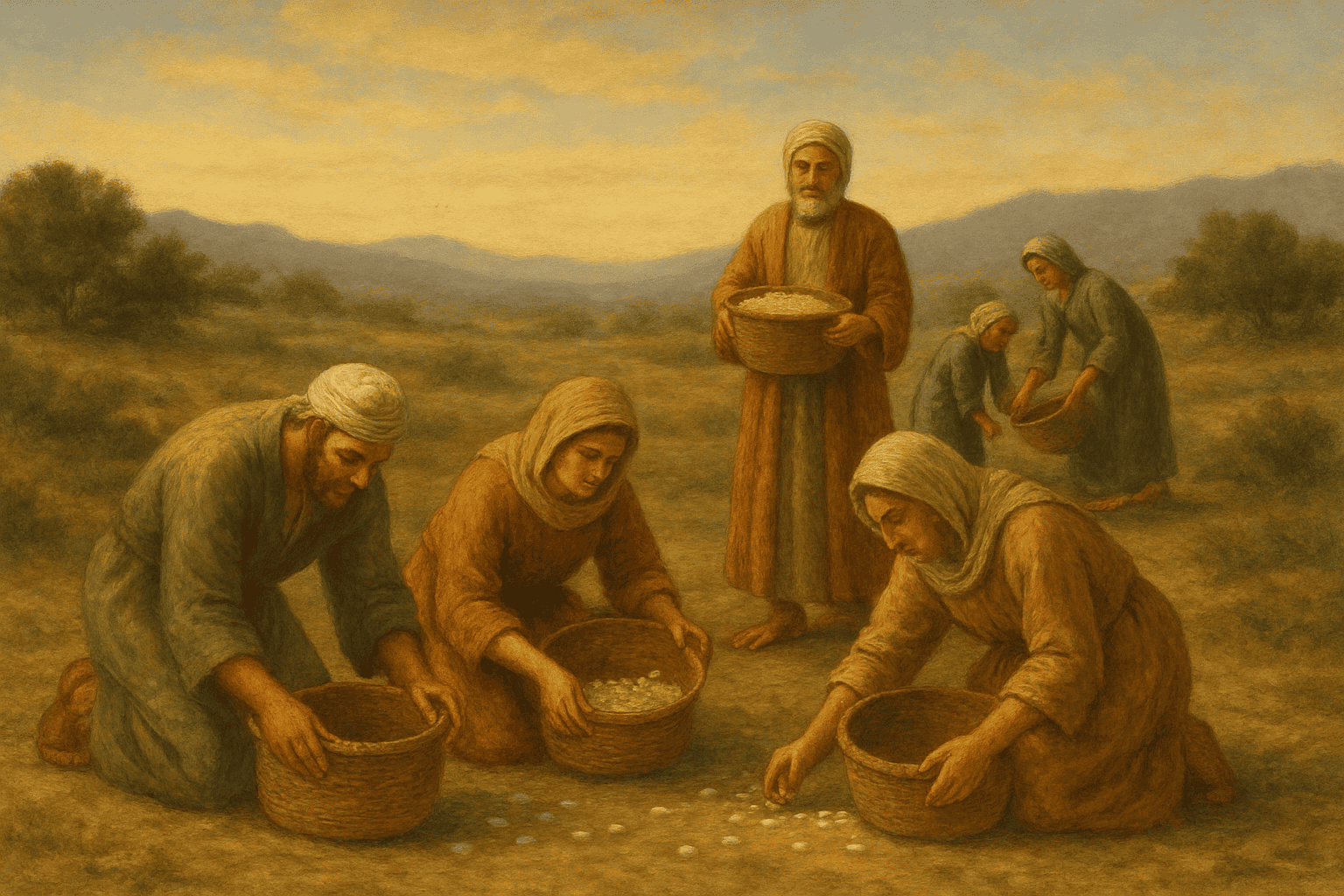
To fully understand this, we’ll look back to when God freed the Israelites from slavery in Egypt. As they journeyed through the wilderness, He became their guide, their protector—and their provider. For forty years, God sustained His people with bread from heaven: Manna. This daily provision wasn’t just about food; it was a lesson in trust, obedience, and dependence on Him.
God Provides in the Wilderness
In Exodus 16, we meet the Israelites about two and a half months into their journey after leaving Egypt. They had just passed through the Red Sea, where God miraculously parted the water for them and destroyed the Egyptian army pursuing them (Exodus 14). After witnessing this miracle, “the people feared the Lord, and they believed in the Lord and in his servant Moses” (Exodus 14:31). The people rejoiced and worshiped God with singing and dancing (Exodus 15).
But shortly after their rejoicing, there is a shift. In Exodus 15:22–25, we read that as they travelled for three days through the wilderness without finding water, they came to a place called Marah (which means bitter), where the water was undrinkable. Here, the people began “grumbling” and asking Moses what they should drink. Moses turned to the Lord for guidance, and God showed him a log. When he threw it into the water, the water became sweet.
At this point, the Lord gave them a command:
“If you diligently listen to the voice of the Lord your God, and do what is right in his eyes, and give ear to his commandments and keep all his statutes, I will put none of the diseases on you that I put on the Egyptians, for I am the Lord, your healer.” — Exodus 15:26
From there, they came to Elim—an oasis with twelve springs and seventy palm trees—where they camped for a while. Then, in Exodus 16, we find them departing Elim for the wilderness of Sin.
It’s important to remember that God was leading them the entire time. In Exodus 13:21–22, we read:
“And the Lord went before them by day in a pillar of cloud to lead them along the way, and by night in a pillar of fire to give them light, that they might travel by day and by night. The pillar of cloud by day and the pillar of fire by night did not depart from before the people.”
The Lord led them into the wilderness of Sin, a region between Elim and Mount Sinai. But here, the entire congregation of Israel grumbled against Moses and Aaron. They complained that they had no food, even saying they would have rather died in Egypt—where they had pots of meat and plenty of bread.
Just like that, they forgot the suffering of slavery. They forgot the greatness of God that they had just recently witnessed.
Yet God responded not with anger, but with kindness. He told Moses that He would rain bread from heaven for the people. But He also gave instructions – a test to see whether they would obey His commandments:
“Then the Lord said to Moses, “Behold, I am about to rain bread from heaven for you, and the people shall go out and gather a day’s portion every day, that I may test them, whether they will walk in my law or not. On the sixth day, when they prepare what they bring in, it will be twice as much as they gather daily.” – Exodus 16:4-5
So, Moses and Aaron said to all the people of Israel, “At evening you shall know that it was the Lord who brought you out of the land of Egypt, and in the morning, you shall see the glory of the Lord, because he has heard your grumbling against the Lord. For what are we, that you grumble against us?”
Moses and Aaron reminded them that it was God who brought them out of Egypt, it was God who was guiding them and it was God who would provide for them. Their “grumbling” was therefore against God, not his servants (Moses and Aaron).
After God had spoken that evening, He provided quail as meat and the following morning when the dew lifted from around their camp, they saw a fine flake like substance “on the face of the wilderness” (Exodus 16:14 ESV). They didn’t know what it was and called Manna –which means “what is it?” in Hebrew.
What Was Manna? A Closer Look
Let’s take a look at the description of manna in Exodus 16:13–15:
“In the morning dew lay around the camp. And when the dew had gone up, there was on the face of the wilderness a fine, flake-like thing, fine as frost on the ground… Moses said to them, ‘It is the bread that the Lord has given you to eat.’”
The Hebrew word man hu literally means “What is it?”- a question the Israelites asked when they first saw this strange substance covering the ground. They had never seen anything like it before.
Exodus 16:31 tells us that manna was white like coriander seed and tasted like wafers made with honey. Later in Numbers 11:7–9, we learn it looked like bdellium (a resin produced by certain trees).
They could grind or beat it and bake it into cakes. It fell with the dew and melted in the heat of the sun if not gathered early.
God instructed them to gather only as much as they needed for each day – an omer per person in each tent (about 2 liters). They were not to keep it overnight, except on the sixth day, when they were to gather double for the Sabbath. This was the test. They had to trust God to provide for them daily.
On the first night, some disobeyed and kept leftovers overnight, but it rotted and was filled with worms. God was teaching them a rhythm of daily gathering so they could learn to depend on Him every single day and to honour His provision by resting on the seventh day.
Psalm 78:24–25 poetically calls manna “the grain of heaven” and “the bread of angels.” Though it was a physical food, it was also a sign of God’s supernatural care.
Manna wasn’t just food—it was a daily test of obedience, trust, and rhythm. It reminded the people that life didn’t depend on what they could store or control, but on God’s faithfulness to provide each day.
The Purpose of Manna: Teaching Trust and Obedience
Manna was more than a miracle of provision, it was a tool for training the hearts of God’s people. In Exodus 16:4 ESV, God said to Moses:
“Behold, I am about to rain bread from heaven for you, and the people shall go out and gather a day’s portion every day, that I may test them, whether they will walk in my law or not.”
God wasn’t just feeding them, He was shaping them. By giving them food one day at a time, He was teaching them to trust Him for their needs without taking things into their own hands or fearing lack. The rhythm of collecting manna morning by morning was a spiritual discipline.
The test was simple: gather only what you need, trust that more will come tomorrow, and rest on the seventh day. But the deeper lesson was this: God is faithful. He keeps His promises, even when the journey is uncomfortable.
In Deuteronomy 8:2–3 ESV, Moses reflects on this wilderness journey:
“And you shall remember the whole way that the Lord your God has led you these forty years in the wilderness… that He might humble you, testing you to know what was in your heart… And He humbled you and let you hunger and fed you with manna… that He might make you know that man does not live by bread alone, but by every word that comes from the mouth of the Lord.”
Manna was God’s daily reminder that their true source of life wasn’t food, it was Him.
This is where we see the heart of Jehovah Jireh, “The Lord Will Provide.” God didn’t just provide a one-time solution. He provided daily, patiently, faithfully, and even when the people doubted. If you’d like to explore this name of God more deeply, I’ve written a study on Jehovah Jireh here that expands on His character as our provider.
Jesus: The True Bread from Heaven

In Deuteronomy 8:3, Moses reminds the Israelites that God fed them with manna to teach them something deeper:
“Man shall not live by bread alone, but by every word that comes from the mouth of the Lord.”
Centuries later Jesus quotes this exact verse when He is tempted in the wilderness (Matthew 4:4). After 40 days of fasting, Satan tempts Him to turn stones into bread. But Jesus responds with the truth: real life isn’t sustained by food alone, but by trusting in God’s Word. This sets the stage for one of Jesus’ most powerful teachings in John 6. After miraculously feeding a huge crowd, He tells them not to chase after food that spoils, but to desire the true bread that gives eternal life:
“For the bread of God is He who comes down from heaven and gives life to the world.” — John 6:33 ESV
“I am the bread of life. Whoever comes to me shall not hunger, and whoever believes in me shall never thirst.” — John 6:35 ESV
What does that mean?
Just like manna was God’s provision in the wilderness, Jesus is God’s provision for our souls. He nourishes us spiritually. When we believe in Him and receive Him daily – through His Word, through prayer, through surrender – He fills the deep hunger in our hearts for meaning, peace, and hope.
Manna kept the Israelites alive in the desert for a season. But Jesus, the Bread of Life, gives eternal life. He satisfies not just for a day, but forever. And He invites us to come, not once, but again and again.
“I am the living bread that came down from heaven. If anyone eats of this bread, he will live forever.” – John 6:51
This isn’t about physical bread. It’s about relationship. Dependence. Trust. Just as the Israelites had to gather manna daily, we are invited to come to Jesus daily. He is enough for our wilderness. He is the true bread from heaven.
Daily Bread, Daily Trust

The story of manna in the wilderness is not just ancient history – it is a living picture of how God relates to His people. It reminds us that God sees our needs, hears our grumbling, and responds with grace. He invites us to trust Him – not with a week’s supply, but day by day, moment by moment.
Jesus, the true Bread from Heaven, is the ultimate fulfilment of that invitation. In Him, we find not just temporary relief, but eternal satisfaction. He is our portion, our strength, and our source of life. Just like the Israelites had to gather manna morning by morning, we are called to come to Jesus each day – to be nourished by His Word, to rest in His presence, and to walk in trust and obedience.
Whether you’re in a wilderness season or walking through abundance, the lesson remains the same: we don’t live by bread alone, but by every word that comes from the mouth of God. And when we come to Him – again and again – we find He is always enough.
Reflect & Respond

- What steps can you take this week to trust God more intentionally for your daily needs?
Is there an area where you’re tempted to “store up” instead of trust? - What are five “ordinary” things you’re grateful for—daily provisions from God that you often overlook? Take a moment to thank Him for each one.
- What might it look like for you to build a daily rhythm of spiritual dependence—like gathering manna each morning?
(Ideas: time in the Word, quiet prayer, worship, journaling.) - How does it change your view of God to know that He provides faithfully—even when we forget or grumble?
Write a short prayer or statement of trust in response.
Prayer
Heavenly Father, thank you for providing for me each day. Thank you for new mercies, morning by morning. Help me to look to You and You alone as my provider for every need – spiritually, physically, mentally and emotionally. Forgive me for the times I relied on myself or other things more than trusting in You. Thank you for being my daily bread. In Jesus name, Amen.
No responses yet